News
·
The Best Business in Finance Nobody Can Enter
Index licensing is one of the highest-margin businesses in finance. Five firms control 95% of it. Here's what it takes to build one now.

Most people picture an index as a number on a screen. The S&P 500 up half a percent, the Nasdaq down a point. Behind that number sits one of the most profitable business models in finance, and for most of its history only a handful of companies have dominated the market.
What an index actually is
An index is a rules-based measure of a market or a defined set of assets. It can track a basket of assets or a single one, but the core idea is the same: a defined methodology produces a number, that number is maintained, and product issuers license the rights to create products based on it, such as ETFs and futures.
The crucial part is what the index provider does not do. It does not trade, take positions, or run the products built on the index. Someone else launches the ETF, the futures contract, or the perpetual. The provider maintains the number and earns licensing fees for the right to reference it.
Where the money comes from
Start with a single fund. State Street charges investors 9 basis points a year to hold SPY, its S&P 500 ETF. Three of those basis points go to S&P Dow Jones for the right to track the index, plus a flat $600,000 a year. A third of the fee an SPY investor pays goes to the firm that maintains the number. SPY held $648 billion at the end of March, which puts that licensing bill at roughly $195 million a year, from one fund.
Scaled across a whole book of licensees, the economics look like this. S&P Global's Indices division generated $1.85 billion in revenue in 2025, up 14%, on segment operating profit of $1.27 billion. That is a 69% operating margin. MSCI's Index segment generated $1.79 billion at a 76.4% adjusted EBITDA margin.
The more interesting number is inside MSCI's index revenue. Of that $1.79 billion, $770.7 million came from asset-based fees rather than flat subscriptions. Those fees grew 17.2% last year. Subscription revenue grew 8.6%. Assets in ETFs linked to MSCI equity indexes stood at $2.34 trillion at the end of 2025.
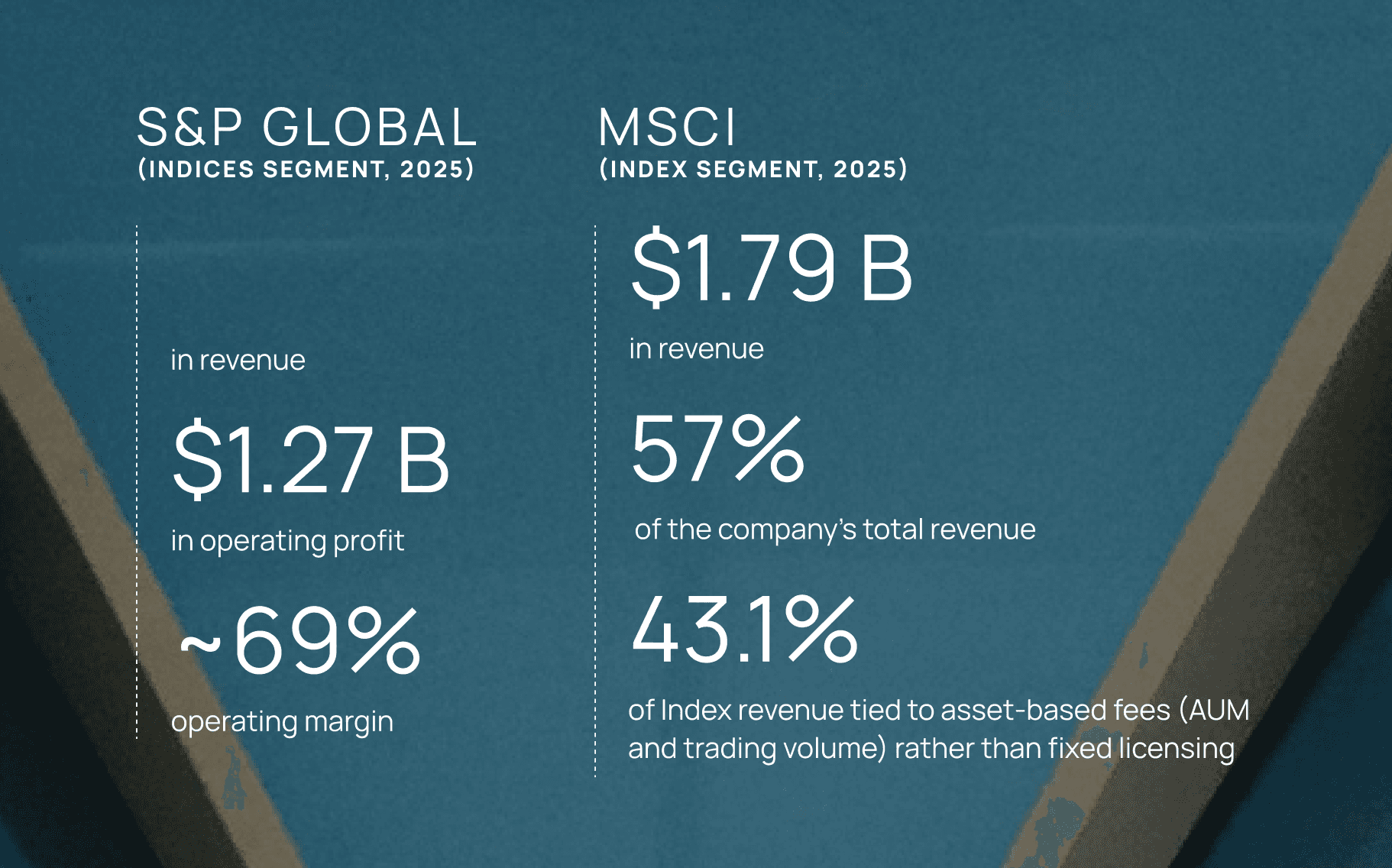
Based on the example of MSCI’s Index business, 43% of the revenue does not grow when the provider sells harder. It grows when the markets built on top of the index grow. The provider's revenue curve is bent by other people's success.
Why almost nobody can build one
Five index providers, S&P Dow Jones, CRSP, FTSE Russell, MSCI, and Nasdaq, account for roughly 95% of assets in the US equity ETF market. S&P Dow Jones alone accounts for more than half. And two things stand between a would-be entrant and that market.
Data. To build an index you need high-quality underlying prices and the rights to use them. Historically that data has been gated, expensive, and slow to access. A would-be index builder licenses it from exchanges and vendors at significant cost. Continuous indices raise the bar further. To maintain an index that prices around the clock, you need continuous data across asset classes, including the hours when traditional venues are closed.
Distribution. An index nobody references is worthless. Revenue arrives only when an exchange, an issuer, or an application decides to build a product on top of it.
The demand the incumbents were not built for
A new set of venues now needs indices the established providers were never structured to supply.
Exchanges, prediction markets, and onchain applications trade equities, commodities, and FX around the clock. They need a price that holds continuously, on assets that were never priced that way. They also move quickly, launching new markets on a timeline measured in weeks, and want indices built and maintained to match.
The legacy model was not designed for either. Its data is more limited when the exchanges close, so a continuous price is not something it can produce. And the commercial process around it is slow and expensive by construction.
What it takes to build in this space
Serving that demand is a different business than the one the incumbents are in. A provider built for continuous, cross-asset indices needs two things the legacy model does not have.
The data, and the new places prices are made. The first-party requirement is unchanged: prices sourced where they are set, not licensed secondhand. What has changed is where that happens. Markets referencing traditional assets now trade around the clock, on leading onchain venues and on centralized exchanges carrying real volume long after the underlying markets close. A modern provider has to reach both.
A methodology that spans the whole day. Price formation for a US equity occurs on traditional venues during regular trading hours and then on venues that continue trading overnight and through the weekend. An index that maintains a continuous price has to incorporate different sources of price formation as trading activity shifts between venues, maintaining a real-time price overnight and through the weekend. The result is an around-the-clock price for 24/5 equities and intermittently traded commodities.
Pyth Indices are live today across equities, metals, commodities, and FX, built on first-party data from the venues where these assets trade at every hour. The set is growing.
Explore Pyth Indices and reach the team here.
Most people picture an index as a number on a screen. Behind that number sits one of the most profitable business models in finance, and for most of its history only a handful of companies have dominated it. This is how the economics actually work, and why the demand now emerging is one the incumbents were never structured to serve.