News
·
Pyth Pro: July 2026 Report
Pyth Pro ARR reached $7.49M in July, up 22% month over month. 51 users converted to paid, and the catalog grew to 3,501 feeds.

Faster than June on nearly every metric that matters.
July continued the momentum from Q2. Usage, customer acquisition, and coverage all moved in the same direction, and the pace picked up from June.
The Q2 review showed the commercial engines built and generating recurring revenue. July's monthly data shows that motion accelerating: more users evaluating Pyth Pro through the Terminal, more conversion through the self-serve funnel, more subscriptions created, and continued expansion of the catalog across asset classes.
July by the numbers
Growth showed up across the funnel, from first visit to paid conversion (figures are month-to-date):
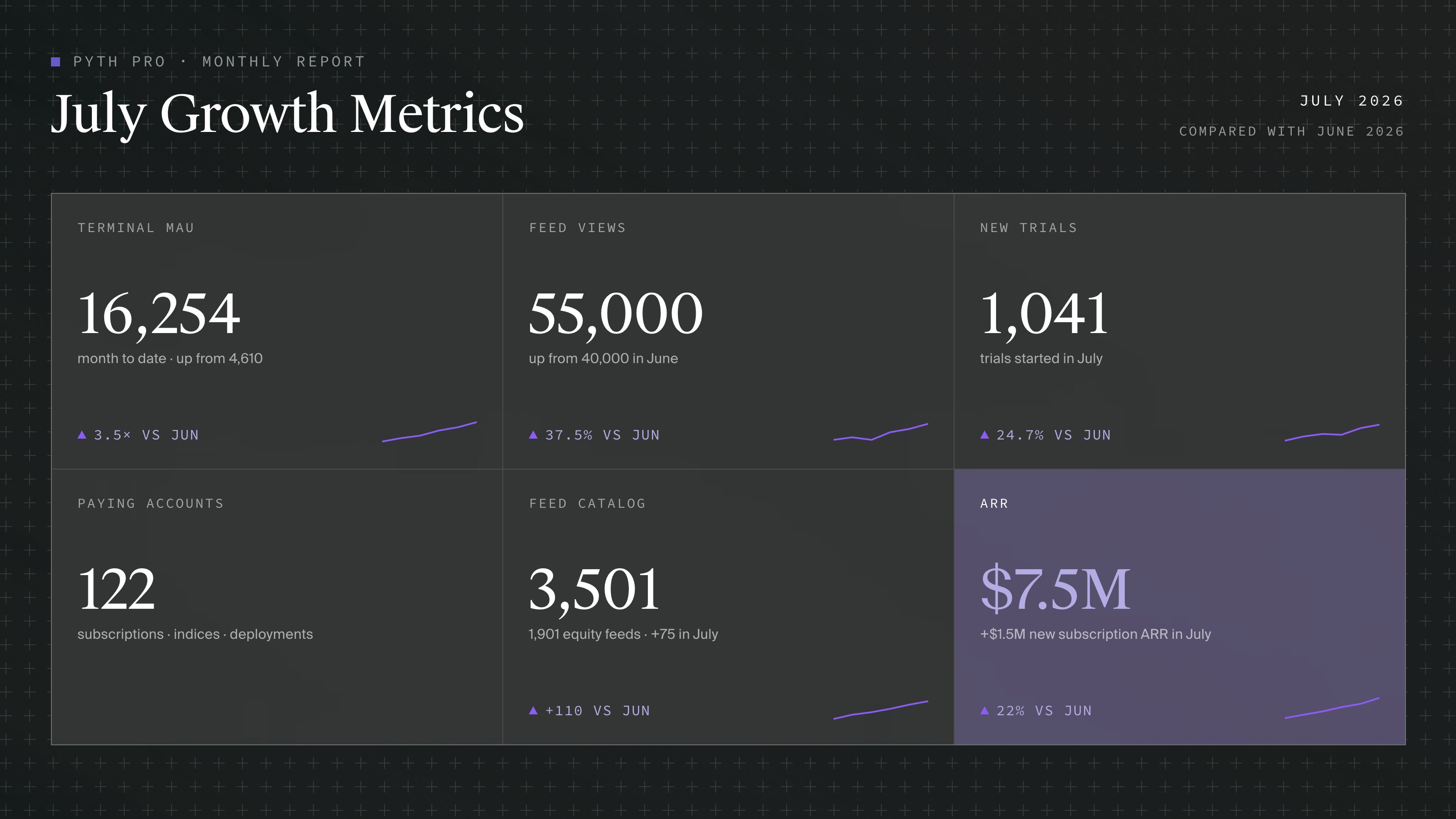
Figures above as per the last report from Douro Labs.
Terminal monthly active users reached 16,254 month to date (up from 4,610 in June).
Feed views reached 55,000, up from 40,000 in June.
1,041 new trials were started in July, up from 835 in June.
51 users converted to a paid plan, adding over $1.5M in new subscription ARR in July.
Paying accounts across Pyth Pro and Indices reached 122, spanning subscriptions, index products, and deployments.
The Pyth Pro catalog expanded from 3,391 feeds at the end of June to 3,501 feeds by July 29.
Equity coverage expanded from 1,826 feeds to 1,901 feeds, with 75 net new equity feeds added in July.
According to Douro Labs’ latest report, Pyth Pro ARR reached a record $7.49M in July, up 22% month-over-month and crossing the $7M ARR milestone for the first time.
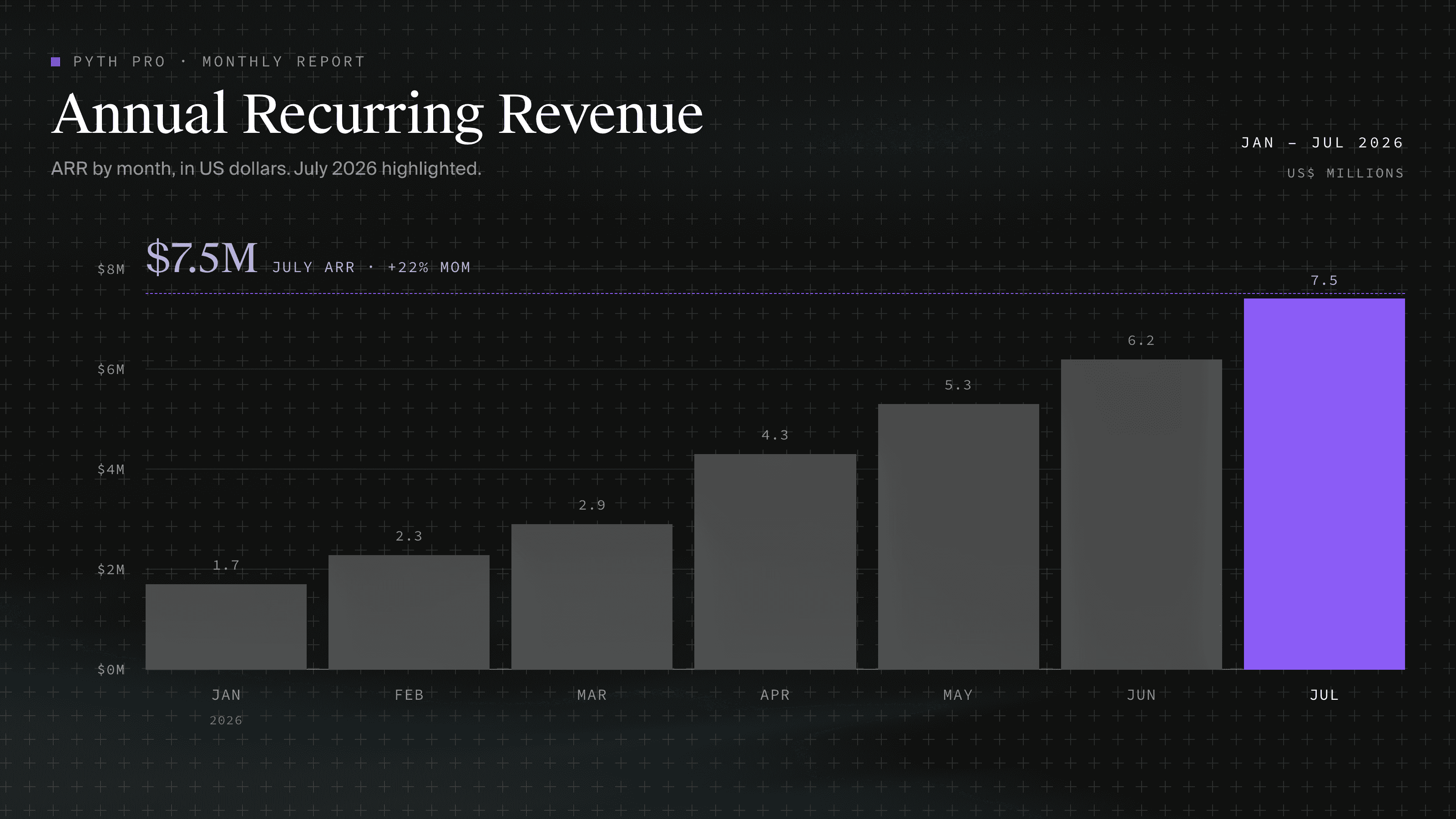
Figures above as per the last report from Douro Labs.
The through-line is that higher-intent actions grew alongside raw traffic. More people arrived in Terminal, and more of them moved deeper into the funnel: exploring feeds, starting checkouts, generating API keys, and converting to paid.
This is what Terminal was built to do. Legacy market data sales run through procurement, custom negotiation, and manual onboarding. Terminal turns part of that into software, so a user can discover feeds, evaluate coverage, choose a plan, and generate an API key without waiting on a sales cycle. It does not replace enterprise sales. It makes the top of the funnel scale.
Coverage expanded where it matters
Coverage grew across several asset classes in July, with the additions concentrated where they extend what exchanges and applications can build.
Equity coverage led, reaching 1,901 feeds with 75 net new equity feeds added in July, spanning US equities, ETFs, Brazilian equity exposure, and 24/7 index coverage. The month also brought an Asian equities package, adding pricing data for equities listed in Hong Kong, mainland China, South Korea, and Japan, through the same single integration that already delivers US equities, FX, commodities, fixed income, indices, and crypto. Stable, live feeds grew from 1,493 to 1,619 over the month.
Coverage is not a vanity metric. In market data, coverage is distribution power. Every feed added increases the chance that a user can solve more of their data problem through one connection rather than stitching together several vendors. For an exchange, broader coverage means faster listing and product creation. For an application pricing real-world assets, it means more of what it needs from a single source.
That is the difference between a narrow feed and a market data layer, and it is the direction Pyth Pro kept moving in July.
Explore it
The catalog keeps expanding and the funnel keeps converting. For teams building cross-asset, around-the-clock markets, the starting point is the same: explore the catalog in Terminal, generate an API key, and connect to real-time data across every asset class Pyth covers.
Pyth Pro ARR reached $7.49M in July, up 22% month over month and crossing $7M for the first time, according to Douro Labs' latest report. Terminal monthly active users reached 16,254, up from 4,610 in June. 1,041 trials started, 51 users converted to a paid plan, and paying accounts across Pyth Pro and Indices reached 122. The catalog expanded from 3,391 feeds to 3,501, with 75 net new equity feeds and a new Asian equities package covering Hong Kong, mainland China, South Korea, and Japan.