Research
·
Will Prediction Markets Reach $1 Trillion? When Everything Has a Price
This is a placeholder blurb that has maximum of 160 characters. This is for meta description SEO

What prediction markets are, how Polymarket and Kalshi use Pyth data, and why reliable market data matters when markets operate around the clock.
YES. NO. NEED MORE DATA.
That's not a poll. It's the price participants assign to the outcome.
Prediction markets take the most consequential sentences in the world “this will happen or it won’t” and force them to carry a price.
They turn questions about the future into tradable contracts:
Will gold close above a certain price?
Will the Federal Reserve cut rates?
Will a particular team win a championship?
Will inflation print above a threshold?
Will an election land a particular outcome?
A “yes” contract might trade at 65 cents and a “no” at 35. If the contract pays $1 when the outcome is true, the market is effectively pricing a ~65% probability.
But “effectively” hides the real fight. Liquidity. Fees. Market design. Manipulation attempts. And for price-based markets, above all: the data used to determine who gets paid.
Prediction markets don't just speculate about the future, they settle contracts based on what actually happens.
And as more capital piles in, the question stops being “Will people trade the future?” (they already are) and becomes far more uncomfortable: Can the infrastructure used to resolve these contracts keep up with the speed of speculation?
The market is growing faster than most people expected
Prediction markets moved into the mainstream during the 2024 US presidential election. Since then, the category has expanded well beyond politics.
Markets now cover sports, crypto, macroeconomic data, interest rates, weather, company performance, commodities, equities, and other measurable events.
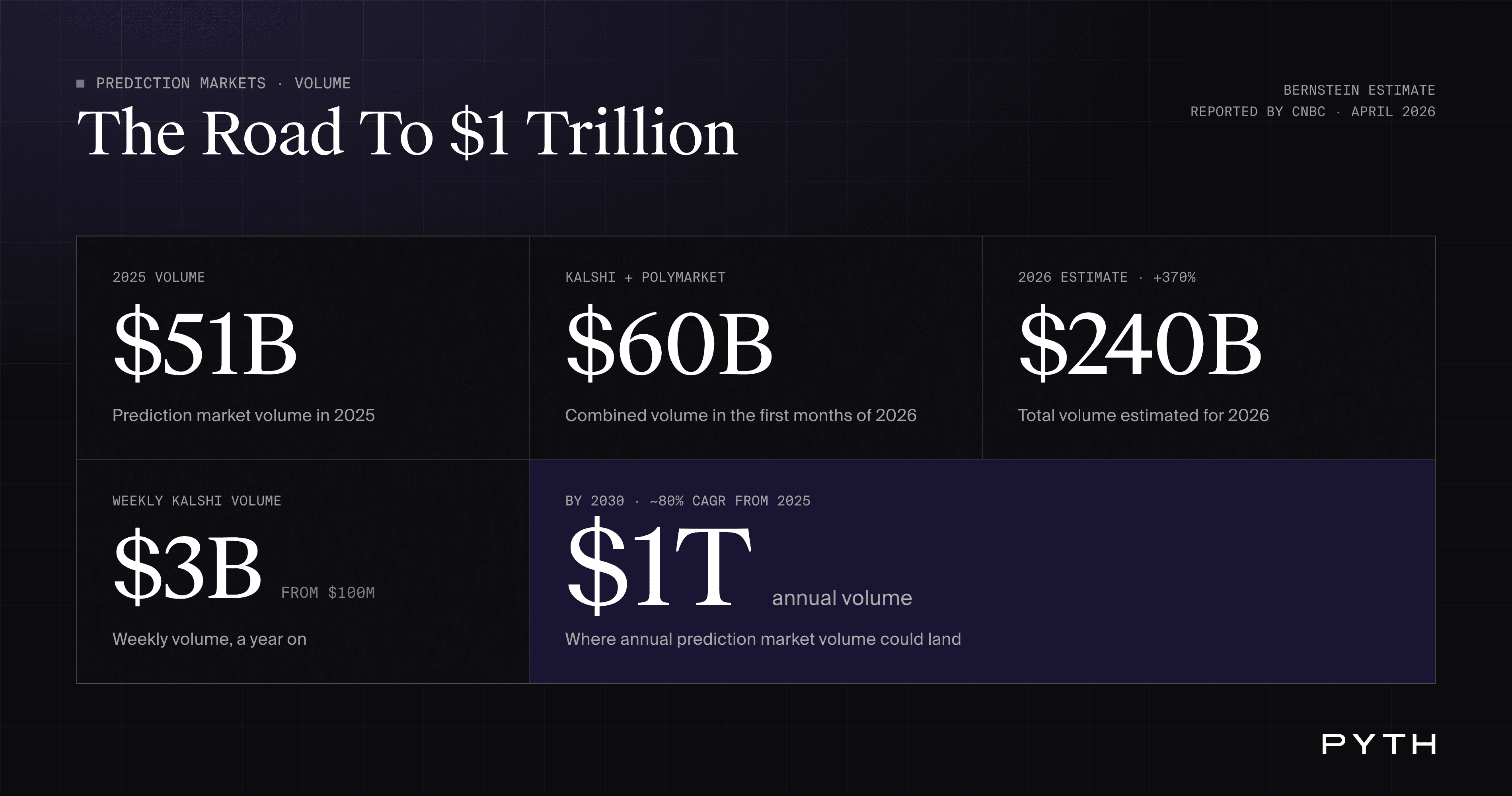
The numbers are beginning to reflect that expansion. According to a Bernstein estimate reported by CNBC in April 2026:
Prediction market volume reached approximately $51B in 2025.
Kalshi and Polymarket had already recorded approximately $60B in combined volume during the first months of 2026.
Total prediction market volume was estimated at $240B for 2026 (a 370% increase from the previous year).
According to a Bernstein estimate reported by CNBC in April 2026, annual volume could reach approximately $1T by 2030, implying roughly 80% compound annual growth from 2025 to 2030.
Weekly Kalshi volume had grown from approximately $100M a year earlier to more than $3B.
These are projections rather than guarantees. Markets still face regulatory, liquidity, surveillance, and market-integrity challenges. Even so, they point to growing institutional interest in prediction markets as a financial product category.
A prediction market is only as credible as its resolution
Consider a simple question:
Will gold trade above $3,500 at 4pm?
The question looks simple. Resolving it is not.
Which gold price should be used? Which market? Which instrument? Which timestamp? Which time zone? What happens if the traditional exchange is closed? What happens during a holiday? What happens if the market trades continuously but the underlying reference market does not? Can participants independently verify the data used?
These are not minor implementation details. They determine whether participants believe the market is fair.
In a prediction market, millions of dollars can depend on a single price point. A stale, delayed, incomplete, or opaque data source can create more than a bad user experience. It can create disputes, weaken confidence, and damage the platform’s credibility.
That makes market data part of the product itself.
For prediction markets, the price of gold, oil, wheat, equities, indices, and interest rates is not background information. It is the answer key.
The 9-to-5 data problem
Traditional markets were built around exchange hours. A commodity market might have a defined trading session. An equity market might close for the day. A futures venue might have its own schedule. A holiday might pause activity entirely.
Prediction markets operate differently.
Their contracts can be available to users at any hour. A market about the price of gold does not stop being interesting because one exchange has closed for the day. A contract about oil, wheat, or an equity can attract participants across time zones, even when the underlying market is between sessions.
This creates a structural mismatch: Markets can be continuous even when the data infrastructure supporting them is not.
That is the problem Pyth is helping prediction markets solve.
How Pyth works with prediction markets
Pyth provides real-time market data sourced directly from institutions that actively participate in price discovery, trading firms, exchanges, market makers, and banks.
With Pyth Pro, prediction markets can access cross-asset pricing through a low-latency interface so they can display fresher prices, cover more real-world assets, use outside-hours pricing where available, and simplify integrations, while giving traders a clearer, more transparent path from live market activity to contract resolution.
Pyth doesn’t decide outcomes: the venue defines the contract rules and resolution logic.
Pyth provides the market-data input they can use within that process.
Polymarket
Polymarket uses Pyth Pro to power traditional-asset prediction markets (e.g., commodities, major index ETFs, and single-name US equities) with real-time streaming prices over WebSocket. By sampling pricing frequently and showing it live, participants can see the “price to beat” as the market trades, making resolution inputs easier to verify and harder to treat as a black box. (Case study)
Kalshi

Kalshi uses Pyth Pro as a resolution source for its Commodities Hub—bringing continuous, transparent pricing to event contracts tied to assets like gold, oil, agricultural products, and industrial metals.
This matters because commodity pricing can move across venues, time zones, and overnight sessions; Pyth helps provide a consistent market-data layer that can support always-on contracts and expansion into additional asset classes over time. (Case study)
Jupiter Predicts
Always better to be predicting with real-time market data. Jupiter Predicts uses Pyth Pro as the solution of choice to power its $BTC and $SPCX markets, helping ensure predictions are anchored to fresh, transparent pricing inputs as markets move. (Case study)
And why the data layer matters more as the market grows?
At small scale, a prediction market can survive with a narrow product range and a manual process.
At larger scale, the requirements change. A serious prediction market needs:
Accuracy: the data must represent the underlying market clearly enough to support a fair contract.
Freshness: prices must update quickly when the underlying market moves.
Continuity: global markets do not stop at one exchange’s closing bell.
Coverage: platforms need access to more than crypto and headline events; they need commodities, equities, indices, FX, rates, and other real-world markets.
Transparency: traders should be able to understand where the price came from and how the contract is being resolved.
Operational simplicity: platforms should not need a separate data architecture for every asset class.
This is the role of market-data infrastructure.
Pyth’s public materials cite more than 710 businesses using Pyth data, over $2.8T in cumulative transaction volume secured, more than 3,000 instruments, 138+ first-party publishers, and 114+ blockchains.
Those figures are network-wide, not prediction-market-specific. But they demonstrate why prediction markets do not need to build their data architecture from scratch.
They can connect to a market-data network already built for cross-asset, real-time financial applications.
The prediction
Will prediction markets reach $1T in annual volume by 2030?
Nobody can know. And that’s the point.
Every prediction market starts as a sentence in the air “this happens / this doesn’t” and ends as a number someone is willing to buy. As volumes rise, the question shifts from whether people will trade the future to what counts as truth when it’s time to settle.
More venues. More assets. More hours. More money on the line.
That makes the resolution layer an increasingly important part of the product.
Pyth provides real-time market data across commodities, equities, indices, rates, and other asset classes, supporting markets that operate around the clock.
The future will always be uncertain. But it’s becoming measurable.
And in prediction markets, everything measurable needs a price.