When the Contract Expires and the Question Doesn't
Learn how constant-maturity commodity indices give institutions stable exposure across futures markets without managing a new contract every month.
Updates

Six constant maturity futures indices went live on Pyth this month: WTI, Brent, Henry Hub natural gas, Henry LD1 natural gas, London WTI and Dutch TTF gas. Each holds a fixed one-month maturity.
The fixed-term problem
Pyth publishes fixed-term futures feeds. Each tracks one listed contract. BRENTU6 is September Brent, BRENTV6 is October, and each stops when its contract expires.
A venue building a one-month oil market against those feeds has to pick a contract, integrate against it, and migrate to the next one before expiry. Every month, forever.
Between migrations, the question drifts. Twenty-five days from expiry, the September contract is a one-month view. Three days from expiry, it is a three-day view. Nothing about the integration changed. The horizon did.
Chaining expiring contracts together creates a second problem. The series jumps at each handover, and the jump is the gap between two contracts rather than a move in oil.
What a constant maturity index does
It holds the time to expiry fixed and lets the contracts move underneath it.
A one-month constant maturity index estimates a synthetic contract expiring thirty days from now. Tomorrow it estimates one expiring thirty days from tomorrow. The maturity never shrinks. There is no expiry to migrate away from.
The convention is old. The US Treasury has published constant maturity yields this way for decades. The VIX has been a thirty-day constant maturity measure since 1993. What has been missing on energy futures is the one-month point, published continuously, in a form a venue can read directly.
How it works
The index tracks the two listed contracts sitting either side of the one-month point, weighted toward whichever expiry is closer. As the calendar moves, the weighting moves with it. The value updates every 50 milliseconds.
There is no roll schedule. Products that hold a constant maturity usually define one: a set of calendar dates on which exposure transfers from one contract to the next. These indices have no roll date. The weighting is a function of where today sits between two expiries, so it moves continuously, and the series does not have a discrete roll-date step.
The six indices
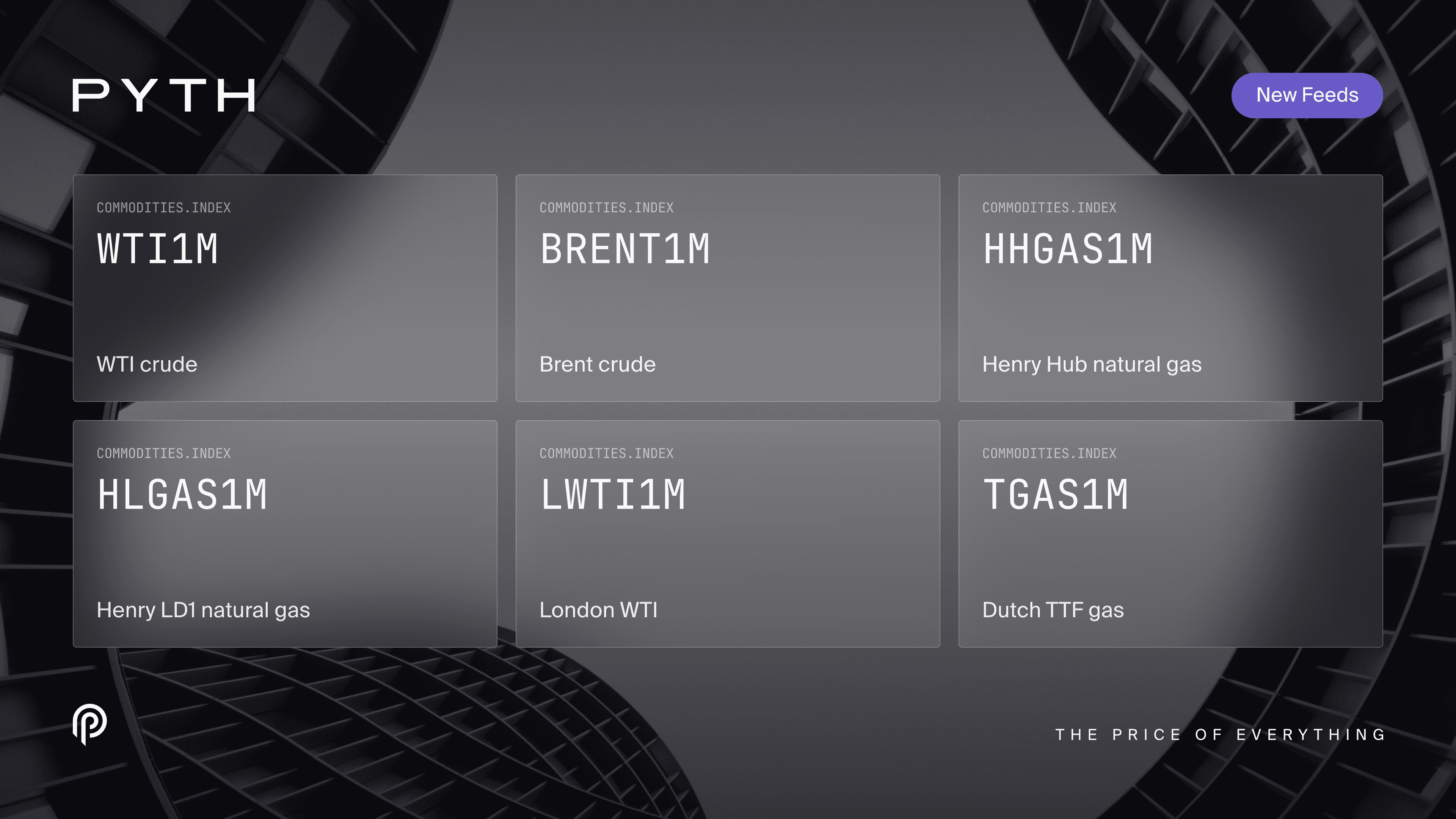
All six are priced in USD to five decimals.
Trading hours
These indices read from listed contracts so they follow the exchange calendar. That means roughly twenty-three hours a day, five days a week: a one-hour daily maintenance break, closed from Friday afternoon to Sunday evening.
When the underlying contracts are not trading, there are no two prices to interpolate between. The index pauses with its inputs.
Pyth's always-on constructed indices, including PYTHOIL, BRENT and NATGAS, are built for the opposite purpose and keep publishing when the exchange is shut. The constant maturity family is built to hold a maturity fixed, not to extend the window.
Access
The constant maturity family is part of Pyth Indices, which carries its own commercial terms. Request access to the Pyth Indices here.
Similar stories

Pyth Pro and Pyth Indices Bring 24/7 Pricing to Stellar’s $4B RWA Ecosystem
Updates

Introducing the New Community Council
Updates

Approval of the Price Feed Council | Oct 2024
Updates

Approval of Pythian Council | Sep 2024
Updates
Where Pyth is Now | Q1 2024
Updates

The Launch of the Inaugural Price Feed Council | Mar 2024
Updates