News
·
RWA Perp Report: August 2026
August RWA perp volume hit $751.9B, up 6.2% from July. Memory reversed, Korea paused, MRNA listed in hours — and Pyth priced 96.27% of it.

August: one book, several clocks
Cash markets do not share a clock and RWA perps don’t wait for them to agree.
August was another record month against the previous report’s published July baseline. The tracked RWA perp market generated $751.9 billion in RWA perp volume, versus $708.3 billion in July, a 6.2% increase.
The market also handled a wider range of situations. Memory equities reversed after a long run higher. Seoul paused program trading during a sharp selloff. Moderna doubled after a clinical readout. Different markets, different schedules, one place to keep trading.
The month was larger AND broader: more assets, more types of event, and more reasons to trade around the clock. Yet, still a lot of market left to build.
Memory equities traded in both directions
July was a one-way memory trade. August brought the other side of it.
The tracked memory complex — SNDK, SKHYNIX, SKHY, MU, SNXX, DRAM, and SAMSUNG — generated $327.4 billion, or 43.5% of August volume. Four of the ten most-traded assets came from the group: SNDK ranked first, SKHYNIX third, MU sixth, and SKHY tenth.
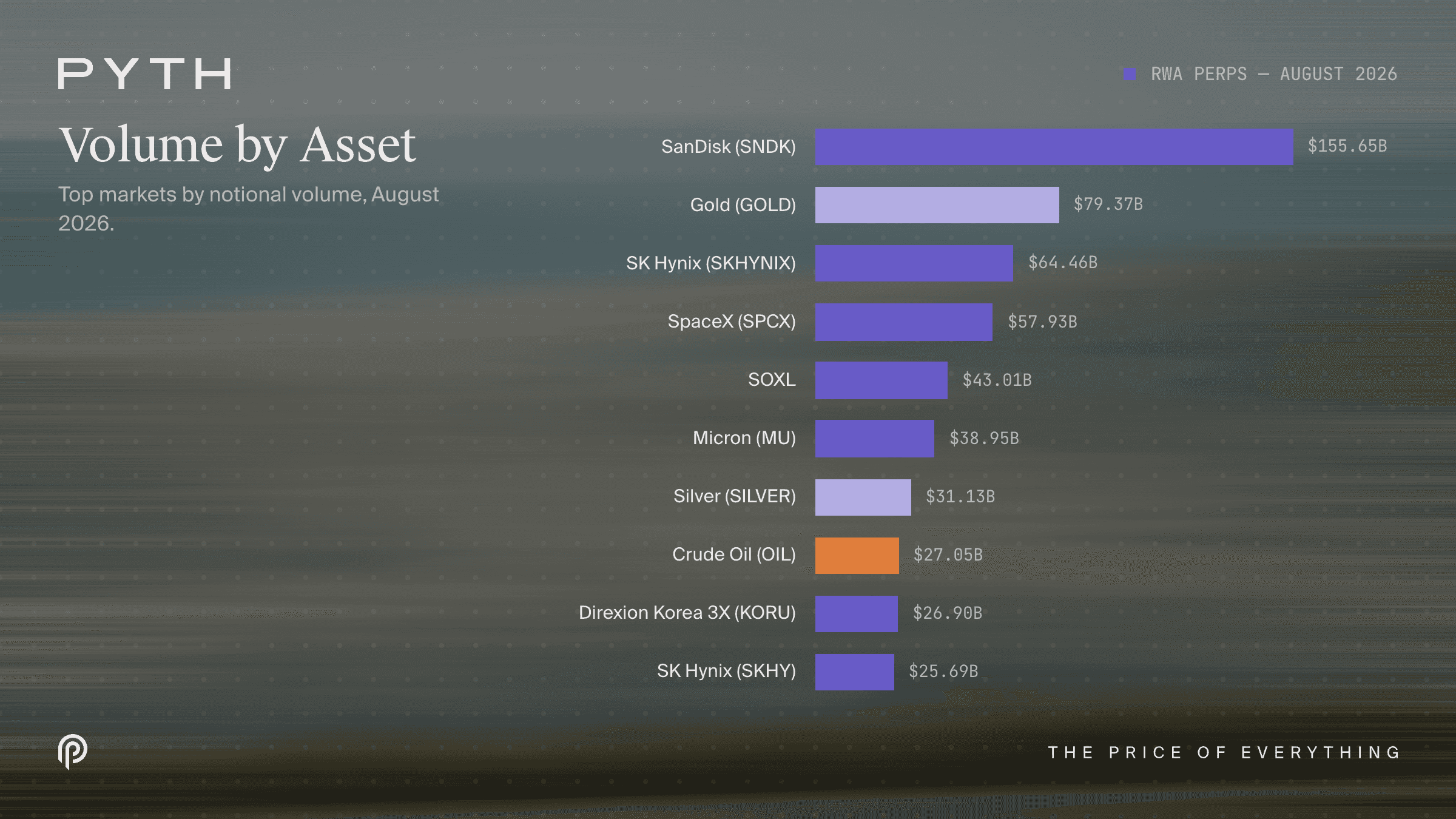
On August 4, the memory trade moved higher. SanDisk rose 8%, Micron 6%, and SK hynix 4% after the companies advanced the first Open Compute Project HBF specification. On August 18, it moved lower: Micron fell 5%, SanDisk 6%, Western Digital 7%, and SK hynix 6% as Treasury yields moved higher and investors repriced the trade.
The same group drove both the rally and the selloff and kept trading through both.
Korea sold off; perps kept trading
Korean exposure was not a side story. SKHYNIX ranked third, KORU ninth, and SKHY tenth. Together, they generated $117.1 billion, or 15.6% of August volume.
On August 19, the KOSPI fell nearly 6% and a Korea selloff triggered a five-minute sell-side sidecar for program trading. After the close, SK hynix announced a 40 trillion won buyback plan, and the KOSPI recovered almost all of the previous session’s loss the next day.
MRNA perps listed in hours. Depth did not.
On August 19, Moderna and Merck reported positive Phase 3 results for their personalised mRNA cancer vaccine in melanoma. Moderna’s stock rose 176.97% in the session.
Very few venues had an MRNA market live before the result; TrueCurrent was one. A few more markets followed shortly after the news broke, including TradeXYZ.
From its August 19 listing through month-end, MRNA generated $571.6 million and ranked 69th by volume. Its first two sessions produced $213.5 million combined, representing close to 40% of its total monthly volume.
The point is access to the event, not the total volume. Traders already have venues for recurring events around the MAG7 and large technology and AI companies, especially earnings. MRNA showed how that can extend to a smaller public company when a one-off clinical result drives attention. With the right risk, and market-data systems, an exchange can make the event tradable quickly, while the news is still relevant and driving volatility.
The 24/7 reference-price problem
August brought a market-structure question into focus: who produces a usable price when traditional market infrastructure is closed, paused, or has not opened yet?
Douro Labs and the Hyperliquid Policy Center brought that question into the SEC’s market-structure process, arguing that the SEC should recognize qualifying independent reference prices for onchain markets where the SIP-derived NBBO is unavailable or does not reflect onchain conditions. The standard they describe rests on direct contributors, a published methodology, transparent publishers, and checks against traditional market data.
A separate SEC comment from the Hyperliquid Policy Center and trade[XYZ] used IPOPs — cash-settled pre-IPO perpetuals with no shares, voting rights, or claim on the issuer — as an example of price discovery before a public listing. The CFTC comment process raises a related question for 24/7 futures and perpetuals in energy markets, where the underlying can keep moving after U.S. futures close.
All point to the same shift: perps are bringing questions of data provenance, instrument classification and market access into policy discussions. That is directly relevant to RWA markets. These issues are directly relevant to Pyth, whose data infrastructure is used across much of the tracked volume.
August in numbers
August closed at $751.9 billion in tracked volume, a 6.2% increase from the previous month.

Asset class ranking
The market is very much still equity-led with $487.3 billion or 64.8% of the total volume. Commodities followed at $152.3 billion (20.3%), then indices at $103.9 billion (13.8%) and FX at $8.3 billion (1.1%).

Venue ranking
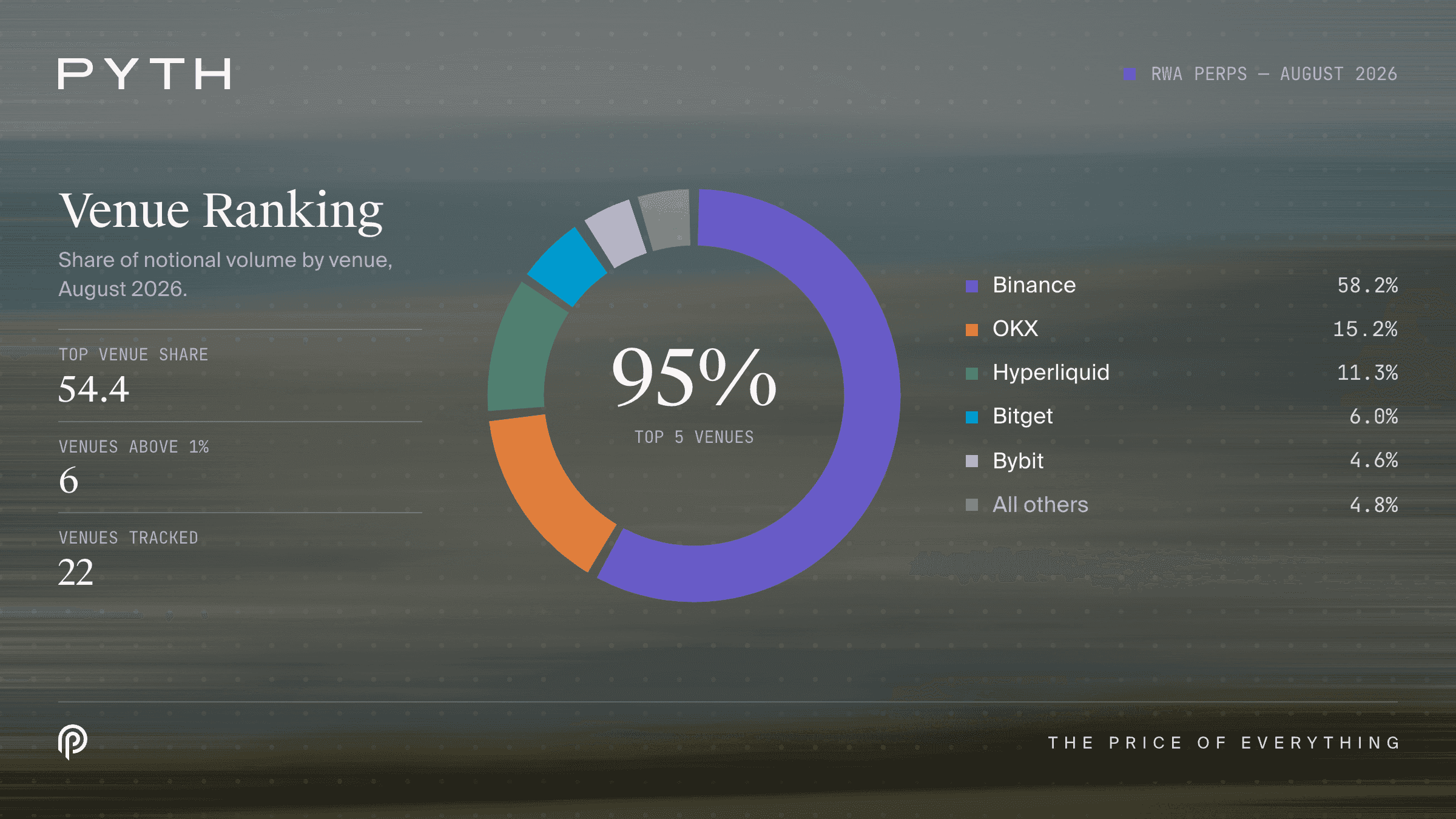
August showcased a reshuffle behind Binance which is head and shoulders above the rest and still growing ($385.6 billion to $437.4 billion). OKX took the 2nd spot as it held its volume above $100 billion and moved from third to second, while Hyperliquid dropped sharply from July’s second-place position to $84.6 billion in August. The RWA perp volume remained top-five concentrated with over 95% of it being traded on Binance, OKX, Hyperliquid, Bitget, and Bybit.
Market-data provider ranking
On the data provider and infrastructure front, Pyth remained the undisputed leader with over $715 billion in RWA perp volume secured, representing 96.27% of the total tracked RWA perp volume. One extra percentage point compared to July further solidifying Pyth Pro and Indices as the products powering 24/7 tradfi markets.

Methodology and sources
All volume, listing and provider figures are drawn from Refraction Research and the RWA Markets dashboard, built by @zinnresearch.
Volume is notional traded volume across tracked perpetual venues.
Volume priced per market data provider attributes each venue-symbol pair to its stated pricing source, weighted by volume. Pairs without a confirmed source are recorded as unverified.
August set another record at $751.9 billion in tracked RWA perp volume, up 6.2% from July. The more useful signal is breadth: memory equities reversed, Seoul paused program trading, and Moderna doubled on a clinical readout few venues had listed. Different markets, different schedules, one clock.


