News
·
Memory Took the Market — RWA Perp Report (July 2026)
RWA perp volume hit a record $708.3B in July, up 69.6% from June. Memory chips drove 81% of the increase — SanDisk, Micron, SK Hynix and SOXL.

July was the biggest month on record for RWA perps. Volume reached $708.3B, up 69.6% from $417.6B in June, and most of the increase came from four symbols. In June this market was led by gold, silver and SpaceX. In July it was memory chips.
Most traded assets of the month
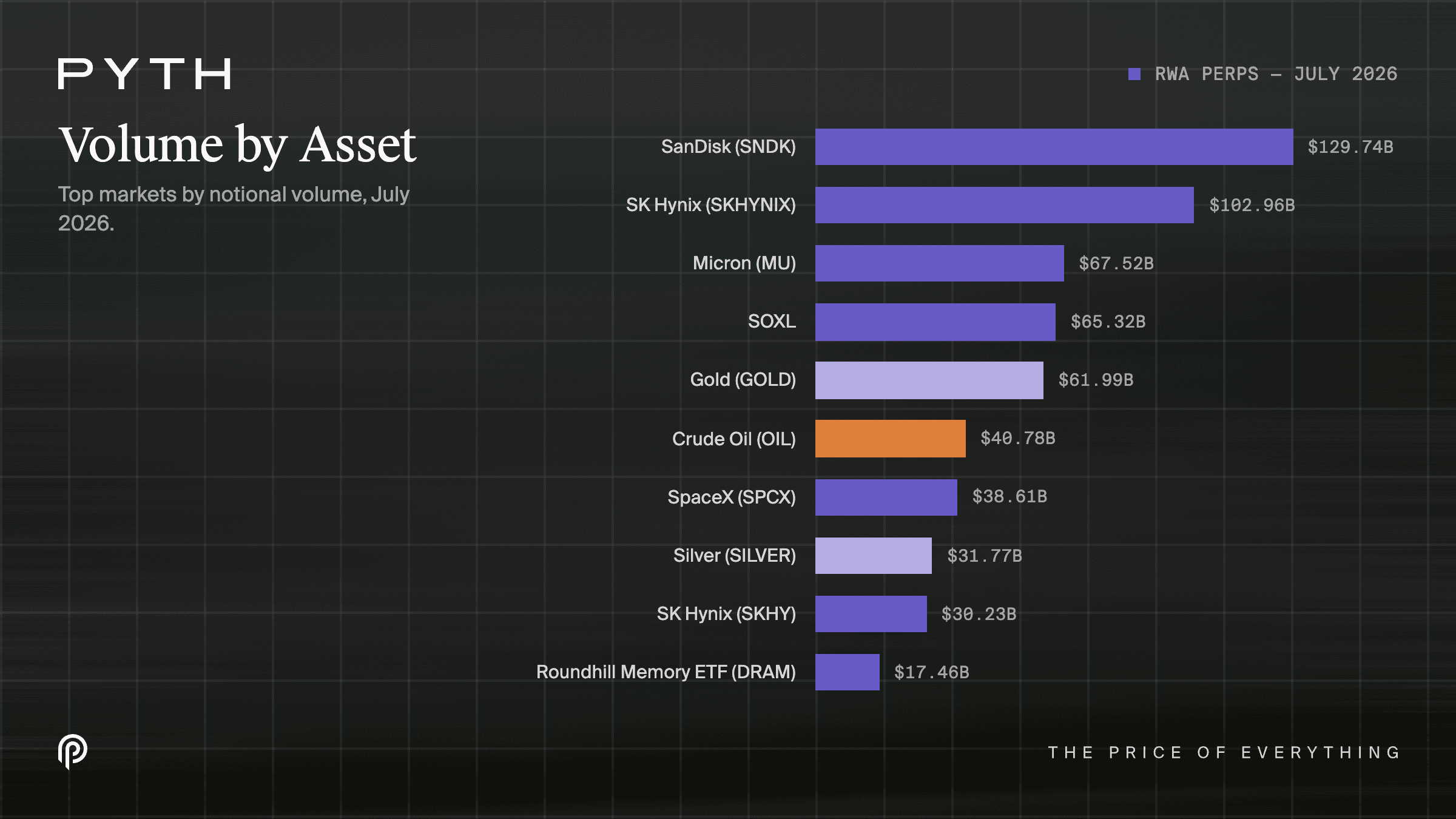
Four of the five are the same bet. SanDisk, Micron and SK Hynix all make memory chips, and SOXL provides 3x daily leveraged exposure to a broad semiconductor index. Between them those four symbols accounted for roughly 81% of the entire market's increase.
Behind that is a memory market in short supply. AI data centres now absorb around 70% of the world's memory chip output, and prices have gone vertical: memory that goes into an ordinary laptop is up nearly 700% over the past year, and SK Hynix's CEO said in July the shortage will probably last beyond 2030. Two listings landed in the middle of it.
SK Hynix’s ADRs began trading on Nasdaq on 10 July following a $26.51B offering, the largest first-time share sale by a foreign company on record. CXMT listed in Shanghai on July 27 and took the whole sector down with it. SanDisk fell nearly 37% over four trading days and then rallied 21.5% in a single morning on July 30. This is the kind of price action and volatility that perp markets thrive on.
Outside of memory, gold stayed the course with a relatively small growth from the previous month (14.6%) just enough to keep a spot inside the top 5. On the losers' side, two assets got ousted from the top 5. SpaceX fell from first to seventh, and silver fell from fourth to eighth. SpaceX’s June volume coincided with its June 12 IPO, which ultimately raised $85.7B, the largest listing in history, and July was the month after.
Asset class ranking
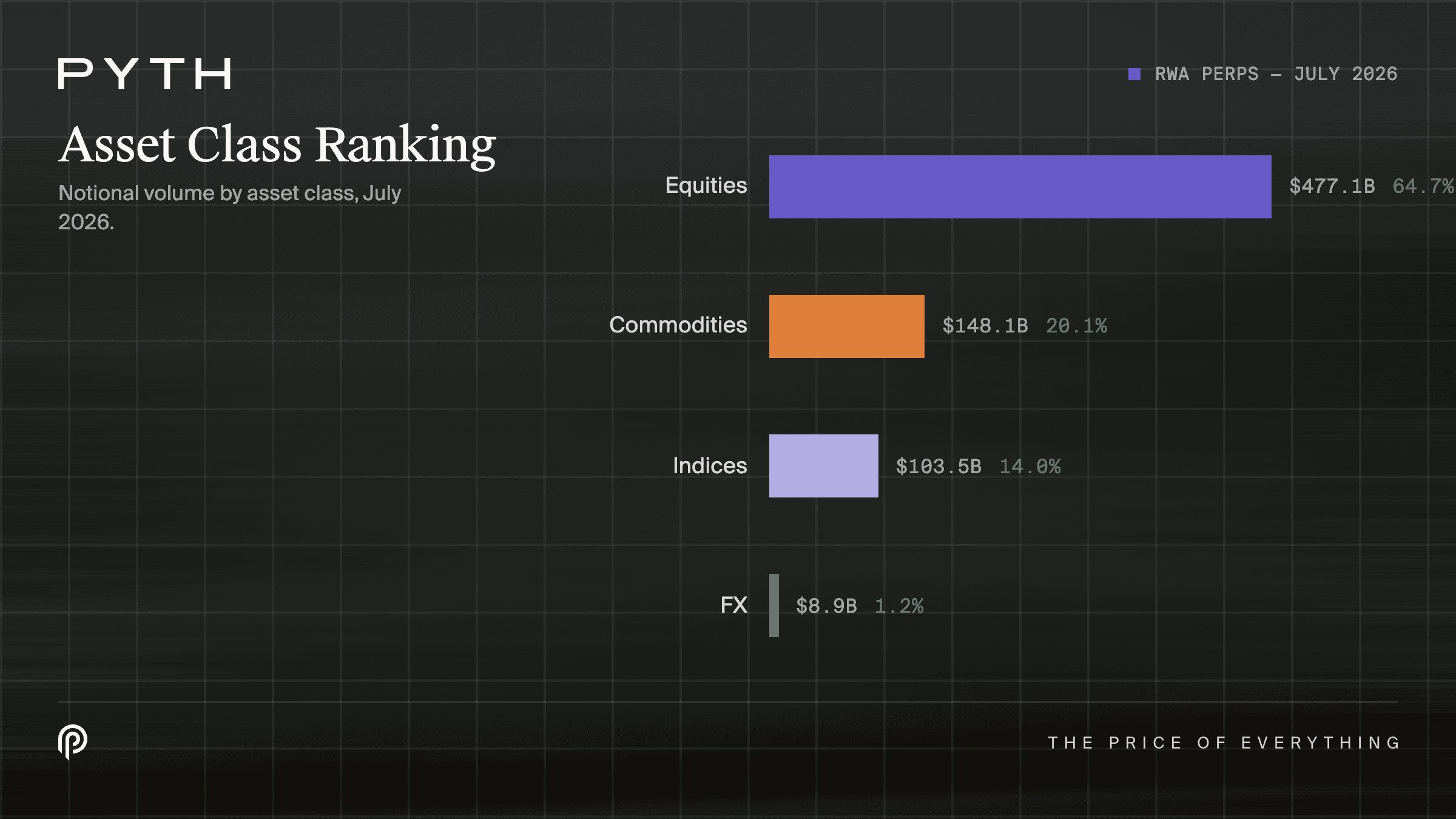
Equity volume more than doubled through three tickers. SanDisk, SK Hynix and Micron added $215.4B of the class's $247B increase.
Commodities grew 15%, from $129.2B to $148.1B, but lost ground because the market around grew five times faster. Gold, oil and silver made up 91% of the class.
Venue ranking
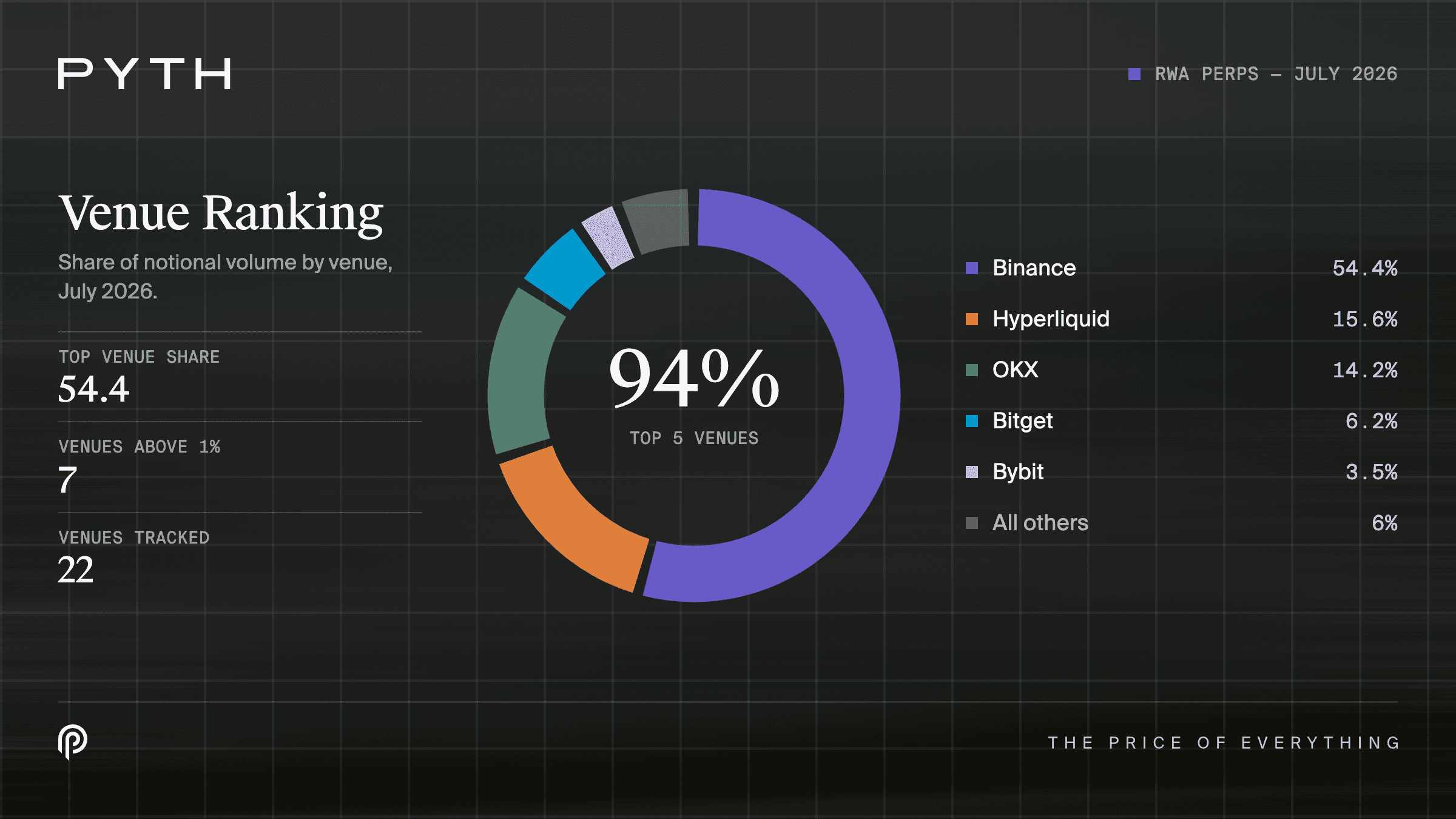
Binance and Hyperliquid ran the month. Between them they handled 70% of RWA perp volume, with Binance alone above 54% and Hyperliquid holding second at $110.7B. The two sit at opposite ends of the category: Binance is where the memory trade found scale, its own top five matching the category leaderboard in the same order, while Hyperliquid is where new assets tend to arrive first. CXMT listed there thirteen days before its shares existed.
OKX took third at $100.7B after doubling its volume, the largest share gain of any major venue. Below that the drop is steep, with Bitget at $43.7B and Bybit at $24.8B.
Growth was widespread rather than concentrated. Every venue in the top five grew, and Hyperliquid and Bitget lost share only by growing slower than the rest. Another interesting movement was further down: volume outside the top five nearly doubled, and the number of venues clearing 1% went from five to seven. Both new entrants, GM Trade and Variational, are commodity books, which is where the metals volume that left the leaderboard ended up.
Volume priced per market data provider
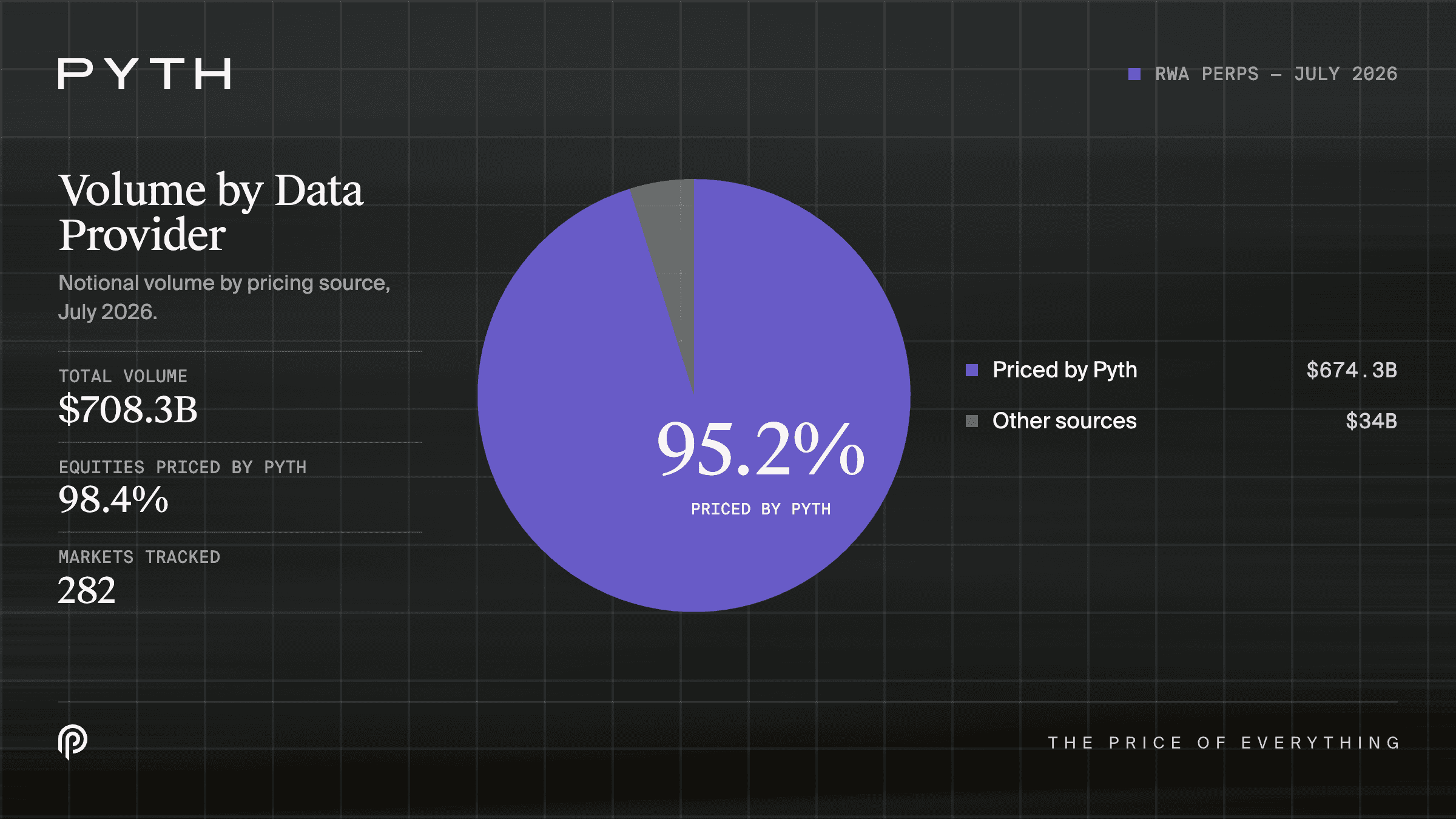
Pyth priced 95.2% of July volume, and its share was highest where the growth was: 99.4% on SOXL and 99.3% on SanDisk. Gold sits at the other end at 87.6%, with four other providers carrying measurable volume.
Moment of the month: CXMT and the pre-IPO perp
CXMT traded as a perp for thirteen days before its shares began trading publicly.
ChangXin Memory Technologies, China's leading DRAM maker, came to market during a year of intense memory demand. Its Shanghai debut closed up 465.8%, giving it a market capitalisation above ¥3.2 trillion and making it the most valuable company listed on a mainland Chinese exchange. Single-day turnover passed ¥140 billion, the first A-share stock ever to do so.
The dashboard records CXMT entering the perp universe in stages:
Date | Venue |
|---|---|
July 15 | Hyperliquid |
July 16 | Lighter |
July 26 | Aster |
July 27 | Bybit |
CXMT generated approximately $737.3M of tracked perp volume, with $709.0M of that on Hyperliquid (96% of the total). Volume accelerated around the debut, reaching approximately $107.8M on July 26 and $248.9M on July 27.
Before the listing, the perp was a market for expectations about a company whose public shares did not yet exist. After the listing, traders had an external cash equity price to converge toward, with Pyth providing that pricing data from the opening trade. The contract moved from pure price discovery toward the familiar problems of tracking, funding, basis and access.
The July 30 funding snapshot showed how much work that convergence still had left. CXMT funding was positive on Hyperliquid at 109.95% APR and negative on Bybit at −434.89% APR, a cross-venue spread of 544.84 percentage points. Seven-day averages were negative on both Hyperliquid and Aster.
The listing did not stay contained to one market. CXMT's debut triggered a global memory sell-off, and a SanDisk's four-day drawdown, which is where a good share of July's record volume came from.
Methodology and sources
All volume, listing and provider figures are drawn from Refraction Research and the RWA Markets dashboard, built by @zinnresearch.
Volume is notional traded volume across tracked perpetual venues.
Volume priced per market data provider attributes each venue-symbol pair to its stated pricing source, weighted by volume. Pairs without a confirmed source are recorded as unverified.
Funding rates are point-in-time snapshots taken July 30 and annualized. Cash equity figures for CXMT, SK Hynix and SpaceX are from public reporting, linked inline.
Four of the five most-traded assets are the same bet. SanDisk, Micron and SK Hynix all make memory chips, and SOXL provides 3x daily leveraged exposure to a broad semiconductor index. Behind them is a memory market in short supply: AI data centres now absorb around 70% of global output, laptop memory is up nearly 700% over the past year, and SK Hynix's CEO said in July the shortage will probably last beyond 2030.