Education
·
IPOs Are Becoming Market Processes
Price discovery starts before listing day and continues across venues after it. What that means for market data, from pre-IPO markets to the opening print.

How Price Discovery Moves Before and Beyond the Listing**
For years, an IPO felt like a single moment on the financial calendar: a company “went public,” a price printed, and trading began.
That picture is getting outdated. More and more, price discovery starts well before listing day, through private funding rounds, secondary transactions, employee liquidity programs, and even live pre-IPO markets. Then the process continues after the ticker starts trading, as liquidity spreads across venues and products that operate well beyond one exchange’s hours.
In other words: the IPO is turning into a market process.
Public markets are reopening, selectively
Listings are returning, but the market’s attention is narrow. Investors are concentrating demand in companies with scale, strong growth profiles, and exposure to long term themes like AI, digital infrastructure, and advanced manufacturing.
According to FTI Consulting’s Q2 2026 IPO & SPAC Market Update, the United States recorded 95 IPOs in Q2, raising approximately $125 billion. Globally, 331 IPOs raised approximately $154 billion, with global deal value increasing 340% year over year.
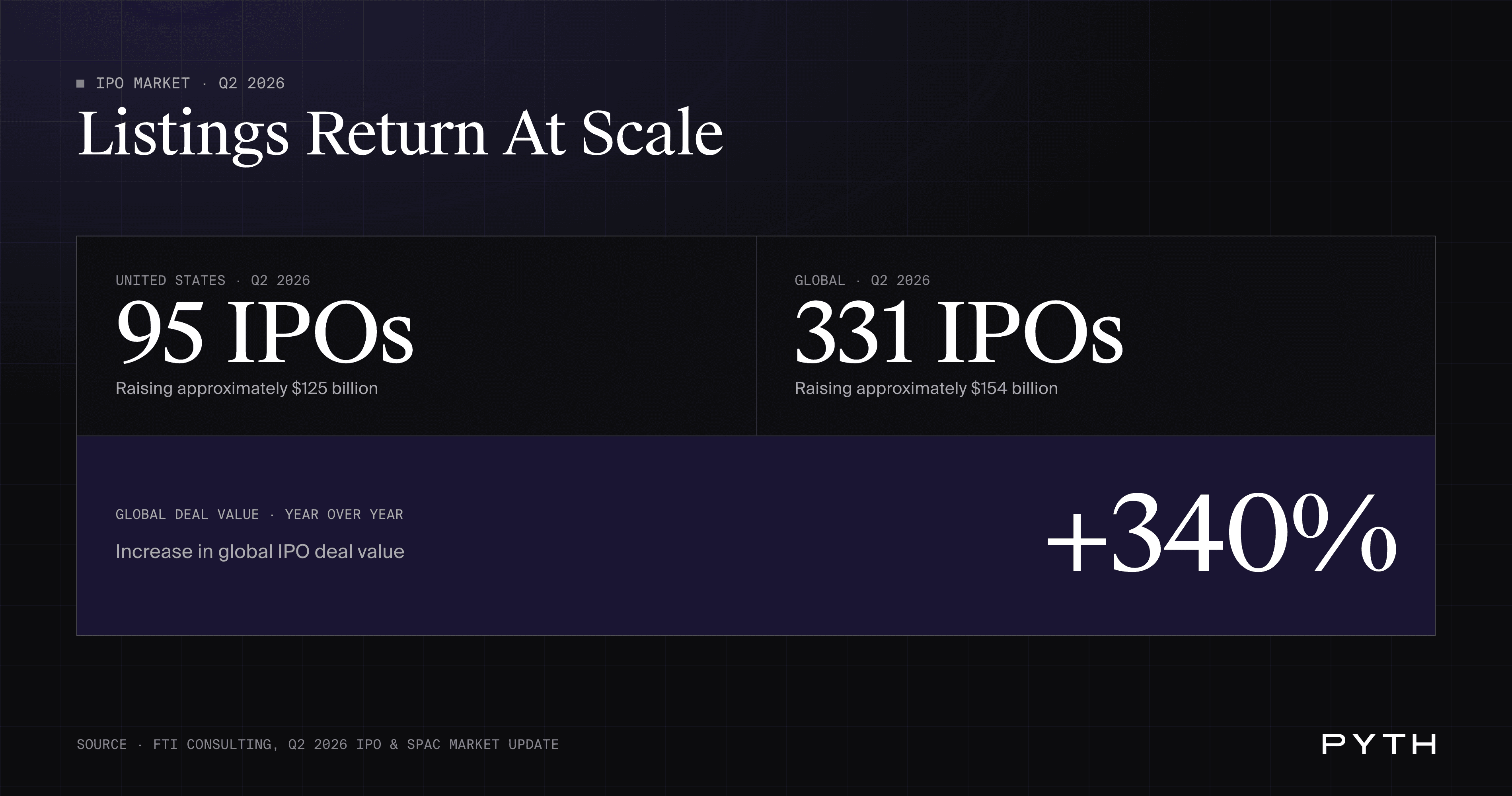
Those headline figures were strongly shaped by SpaceX’s approximately $86 billion offering. That outlier pushed quarterly issuance statistics sharply higher. It also made the underlying message clearer: investor demand is there, and it’s flowing toward large companies with credible growth narratives and a clear role in structural technology markets.
The mix of listing routes is shifting too. SPAC formations represented 54% of U.S. IPO activity in the second quarter, down from 68% in the first quarter. Traditional IPOs are regaining share as confidence improves.
So yes, the market is open. Selectivity remains high.
The offer price is only one reference point
The offer price still carries weight. It’s set through book building, backed by a banking syndicate, and treated as a key reference point going into public trading.
But in practice, companies often arrive at listing day with several competing “prices” already in the wild. Depending on who’s trading, what rights they’re buying, and how liquid the venue is, a company can be referenced by:
Its most recent private market valuation
A price from a secondary transaction
An internal mark used for employee equity
A pre IPO market price
The underwritten offer price
The opening auction price
The price that develops after the first trading session
These numbers can diverge sharply because they reflect different instruments, different liquidity conditions, and different investor groups.
That’s why price discovery increasingly begins before the ticker appears on an exchange. Listing day doesn’t create demand from scratch. It makes the process more visible and extends it into a wider market.
CXMT made disagreement visible before the listing
ChangXin Memory Technologies (CXMT) is a clear example of how early price formation is changing.
According to Pyth’s report on the CXMT listing, the company’s debut on Shanghai’s STAR Market became the largest chip listing in Chinese market history. CXMT priced its shares at 8.66 yuan and raised up to 66.6 billion yuan, valuing the company at approximately $85 billion at the offer price.
Demand was substantial: the retail tranche was oversubscribed 212 times across 9.4 million individual orders.
What’s especially interesting, though, is what happened before that first official trade.
Ahead of the listing, TradeXYZ’s live pre-IPO market gave traders a way to express views on CXMT while the public shares were still unavailable. That market traded at levels implying a valuation of approximately $500 billion.
The gap between the pre IPO market and the offer price wasn’t just noise. It was information. It made disagreement visible early, across venues that were effectively running in parallel. And once CXMT began trading on the STAR Market, the pre IPO market suddenly had an underlying public reference price to anchor against. That shifted the conversation from pure expectation to practical questions like tracking, funding, basis, and liquidity.
The first public trade is becoming an infrastructure event
A newly listed stock has no trading history. Its first price is created through the opening auction, then propagated across the venues, applications, and products that consume exchange data.
That makes the first print more than a headline. It’s an infrastructure challenge.
If a venue wants to launch an equity perpetual, prediction market, or other financial product around a new listing, it needs the price as soon as the public market opens. A feed that arrives an hour later is a description of the past. A feed that’s live from the opening print is part of the market as it forms.
Pyth’s IPO Oracle report frames this through a sequence of same day equity feeds:
Circle (CRCL) in June 2025
Figma (FIG) in August 2025
Cerebras Systems (CBRS) on May 14, 2026
SpaceX (SPCX) in June 2026
The pattern continued with CXMT, which became Pyth’s first day one feed for a mainland Chinese IPO. Pyth’s CXMT release connects that listing to the earlier CRCL, FIG, CBRS, and SPCX feeds.
Each new IPO tests the same question: can market infrastructure follow price discovery as it happens?
IPO markets are becoming continuous
The boundary between private and public markets is getting more fluid.
A company can generate expectations through private transactions, develop a pre IPO market, list on a traditional exchange, and then trade across always on venues that serve users in different time zones. Instead of one clean transition, you get multiple overlapping “market clocks” running at once:
Private market expectations form through funding rounds and secondary transactions.
Pre IPO price formation develops before the listing.
The opening auction creates the first public market price.
Cross venue trading extends the market beyond the listing exchange’s hours.
Applications and financial products continue using the data across global markets.
To keep up, the market data layer has to follow the asset through every stage. That means direct access to the venues producing prices, real time distribution, accurate instrument metadata, and infrastructure that can support the first trade and the market that forms afterward.
The asset behind the price matters
A ticker doesn’t fully describe an asset.
A restricted private share, a thinly traded secondary position, an IPO allocation, a pre-IPO contract, and a freely traded public share can all reference the same company, while carrying different rights, liquidity, and settlement terms.
As tokenized equities, perpetual markets, and new financial venues expand around public listings, those distinctions become harder to ignore. A credible market data system needs to clearly identify the instrument behind the price:
What asset is being priced?
Which market produces the price?
What rights does the instrument represent?
How liquid is the market?
What are the trading hours?
How are corporate actions handled?
What happens when the instrument lists, splits, or changes status?
Pyth’s research on corporate actions and stock splits shows why this matters after the IPO as well. A feed has to account for scheduled events that change the representation of a security, including splits, reverse splits, and delistings.
The opening print begins the public phase, but it doesn’t solve the data problem by itself.
From IPO coverage to market infrastructure
Pyth’s IPO activity shows the same market data requirement repeating across regions and asset classes.
Circle, Figma, and Cerebras demonstrated the need for same day U.S. equity coverage. SpaceX extended that capability to one of the most closely watched listings in the market. CXMT brought the same day model to a major mainland Chinese IPO, and linked pre-IPO expectations with a live, listed price.
Taken together, the sequence points to a broader shift:
Markets form earlier.
Price discovery continues across more venues.
New financial products launch closer to the first public trade.
Data providers need access to the source market from the beginning.
Investors receive more signals, and must understand what each signal represents.
The IPO is increasingly the moment when a private market process becomes visible across a much wider financial system.
For exchanges, that creates demand for feeds that are live from the opening auction. For issuers, it creates a market that begins forming before the listing date. For investors, it creates more information, and a greater need to distinguish valuation, liquidity, and market structure.
For market data providers, the standard is moving from publishing a ticker to supporting the full lifecycle of an asset.
Pyth is building the price layer for that lifecycle: from data reflecting pre-IPO expectations and opening trades to continuous market access across equities, indices, commodities, FX, and other asset classes.
The next generation of IPOs won’t be defined by the offer price alone.
They’ll be defined by how quickly a market can form around a company, how widely it can operate, and how reliably the data can follow it from the first signal to the next phase of trading.
For years, an IPO looked like a single moment on the financial calendar. A company listed, a price printed, trading began. That picture is getting outdated. Price discovery now starts in private rounds, secondary transactions, and live pre-IPO markets, then continues after the ticker appears as liquidity spreads across venues operating well beyond one exchange's hours. CXMT made the gap visible: a pre-IPO market implying roughly $500 billion against an 8.66 yuan offer price valuing the company near $85 billion. For market data providers, the standard is moving from publishing a ticker to supporting the full lifecycle of an asset.